The clinical audit that stays on.
Patient pathways lose time and people at the handoffs. vigilance reads the records, shows a clinician where each patient stalled and why, and reports a number the trust can sign.
Nobody has time to read every note
Clinical audit is how the NHS finds where pathways break. It is statutory, it works, and it stops the moment a ward gets busy, because the data collection is a clinician reading notes by hand.
8min 35 s
to abstract one discharge summary by hand.
28hours
per audit project, mostly unpaid time.
2020
National audit was switched off by letter when the pathways were breaking fastest.
How it works
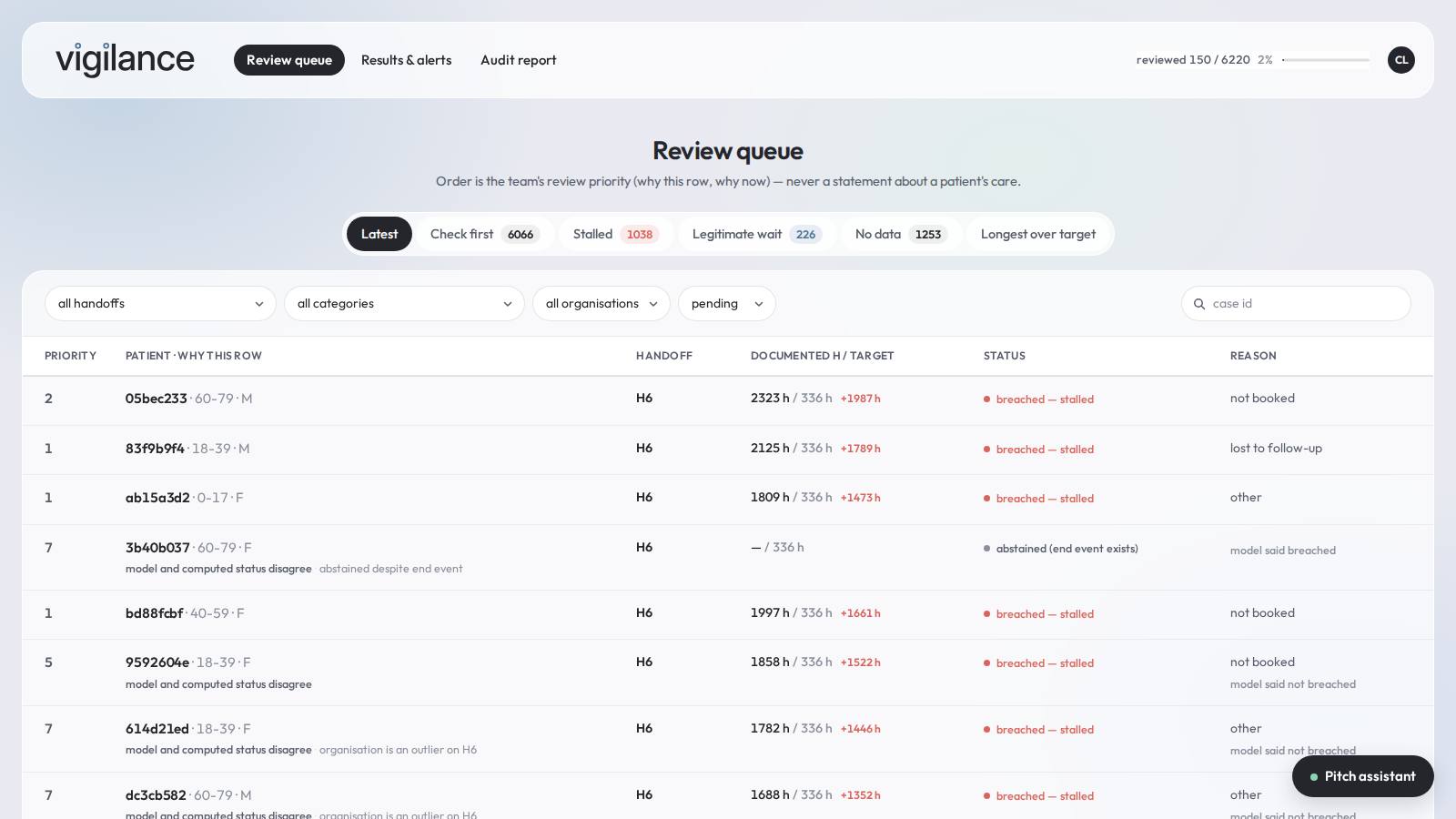
The clinician writes the audit as a protocol: which handoffs, what target, which reasons count as legitimate, who owns the fix. Everything downstream reads from it.
Why you can trust the number
Nothing is invented, nothing is hidden, and the model never has the last word.
Nothing invented
A quote the verifier cannot find on the page gets a red badge and no rectangle. A missing time is an abstain, never a guess.
Stalled, not just late
Every breach carries a reason with a class. An unsigned chart is a stalled patient. Platelets at 38 is a legitimate wait. Only the first counts as time lost.
Honest intervals
Prediction-powered inference keeps the confidence interval valid whatever fraction of rows the clinician managed. Where the model is biased, the model-only interval misses the truth every time; corrected, it holds.
It orders the team's checking, never a patient's care. This is audit, not surveillance.Aggregate outputs only. No per-patient alert, no recommendation, no patient interaction.
Read the audit report